
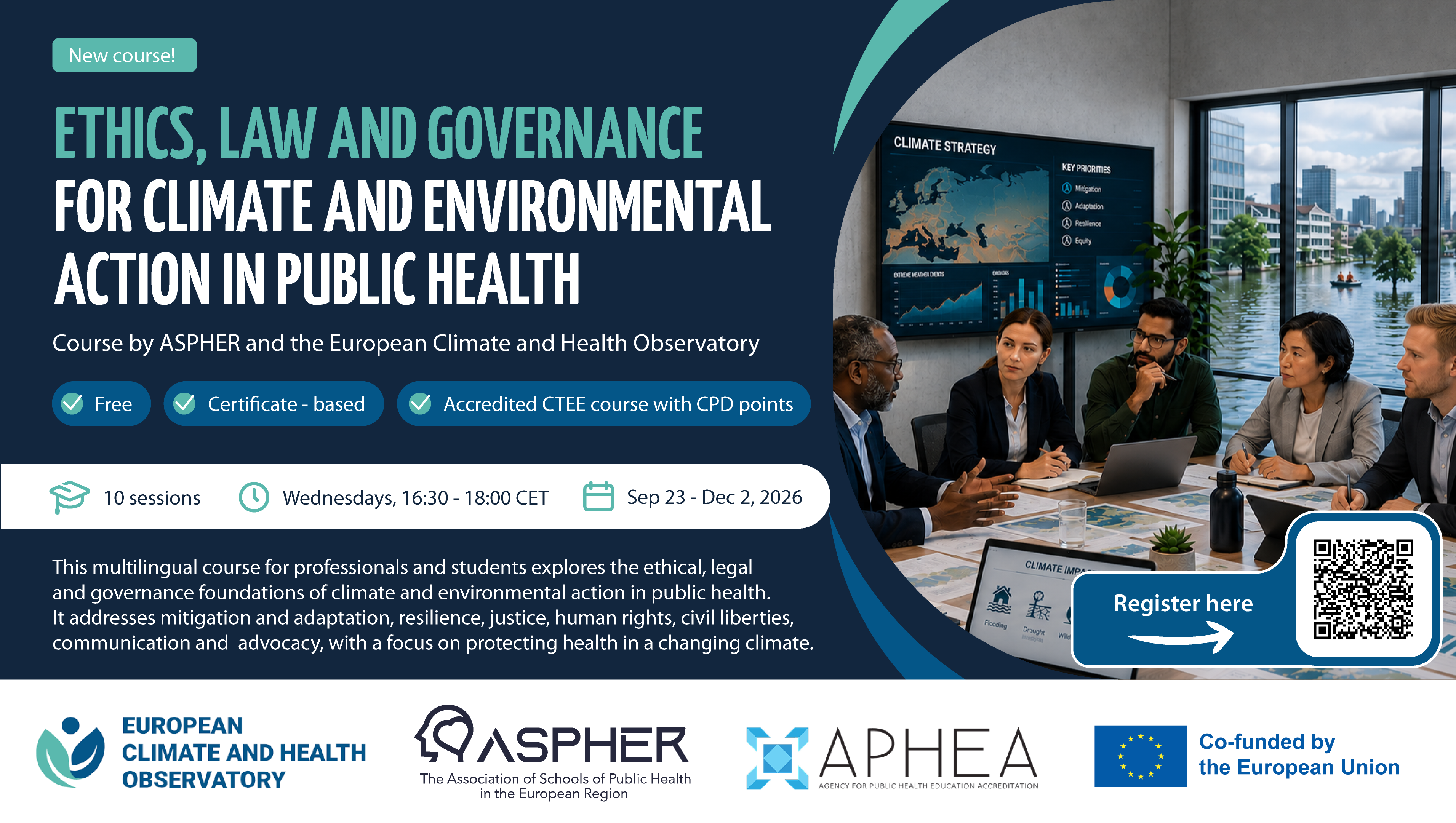
A free APHEA-accredited CTEE course by ASPHER and the European Climate and Health Observatory
Climate change and environmental degradation are among the defining public health challenges of our time. Their impacts are already affecting population health, health systems, equity, human rights, and the legal and ethical responsibilities of public health professionals and institutions. This free APHEA-accredited CTEE course introduces participants to the ethical, legal and governance principles that underpin climate and environmental action for public health. It explores the public health mandate for action, international and European legal frameworks, civil liberties, climate justice, mitigation and adaptation policies, health system resilience, stakeholder engagement, communication, advocacy, and the role of public health professionals in advancing fair and effective responses. The course is designed to support public health professionals, students, policymakers, researchers and others working at the intersection of climate, environment and health. It will provide participants with conceptual tools, practical frameworks and applied examples to better understand how law, ethics and governance can support climate and environmental action. Participants will engage with key debates on ethics and values, public health law, governance structures, climate threats, health system resilience, and the role of policy in shaping fair and effective responses for communities in Europe and beyond.
For professionals and students working in or interested in climate and health, ethics, law and governance. All professionals interested in climate, environment and public health are welcome.
Weekly live-virtual sessions (90 minutes) with the option to watch recordings up to 6 days after each session for asynchronous viewing.
Live question and answer (Q&A), which will be monitored by the programme team, and questions will be consolidated and addressed to expert lecturers.
Most lectures will be delivered in English.
Live course primary language: English, with live-subtitles available in:
The course consists of weekly live-virtual sessions.
Each session will include expert input and opportunities for discussion. Resources such as slide decks, frameworks and suggested readings may be provided to course participants following each session.
Description
This session introduces core concepts in climate change and health, including the definition and drivers of climate change, its direct and indirect impacts on health, and the importance of health adaptation and resilience. It also explores the health co-benefits of climate mitigation, planetary boundaries, and the role of ethics, values, law and governance in climate and environmental action.
Opening Session:
Speakers:
Moderators
Description
This session explores the legal and ethical mandate for public health action in the context of the climate crisis. It examines professional duties, including the duty to warn and the duty to act, and considers tensions between individual liberty and population health. It also introduces the precautionary principle and the subsidiary principle in EU and national legal contexts as foundations for early intervention.
Speakers:
Moderators
Description
This session addresses the applicable UN and Council of Europe legal frameworks, and related climate litigation, through a public health lens. It will examine the legal and health grounds in the climate case of Bonaire v. Netherlands, including the perspectives and contributions of Bonaire residents.
Speakers:
Moderators:
Description
This session will introduce the European Green Deal, Fit for 55 Package, and regulatory tools for different economic sectors. It will discuss the importance of EU treaties, including the European Charter of Fundamental Rights, to health and the environment, and legal obligations in the context of Environmental Health Impact Assessments.
Speakers:
Moderators
Description
This session will share and reflect on some basic principles and ideas around justice, equity and the right to health for climate and environmental action and their implications for good public health policy and practice. Outline the OHCHR report on Priority actions towards breathing clean air, protecting public health and ensuring a healthy environment, including its conceptual framework around interconnectedness and significance to policy and practice. Consider the unequal impact of the climate crisis within and between countries, and perspectives on one health ethics, ecological justice and their implications for policy and practice for climate and environmental action.
Speakers:
Moderator:
Description
This session will consider firstly, insights from the European Group on Ethics in Science and New Technologies (EGE) report on Towards a Just Green Transition: Addressing Structural Inequities, including ideas of justice and solidarity for climate and environmental policy and practice. Secondly, ideas to engender and enhance climate consciousness among health professionals as a key part of their professional roles and responsibilities and actions. Thirdly, insights from the EGE Opinion: Valuing Nature: Implications for EU Governance, focusing on the "urgency paradox" in the light of current polycrises and the fragility of ecological concern in environmental governance.
Speakers
Moderators:
Description
The session will consider: Economic, ethical and political dimensions in governance and resource allocation for climate and environmental policy and action; Processes, structures, and assumptions for climate and environmental governance and implications for action and bridging the action gap; and evidence generation and translation for climate and environmental action and implications for action for health professionals and policy makers.
Speakers:
Moderators:
Description
This session focuses on climate adaptation and resilience in health systems. It examines legal requirements for climate-proofing health infrastructure and supply chains, upskilling the health workforce, ethical principles for resource allocation during acute crises, and governance and liability in disaster preparedness and response planning.
Speakers:
Moderator:
Description
This session explores the role of public health professionals in communication and advocacy for climate action. It considers professional responsibilities in advocating for political action, legal and ethical boundaries of advocacy, protection of freedoms of association, speech and assembly, risk communication ethics, legal compliance in public statements, and distinctions between lobbying, scientific advice and political advocacy.
Speakers
Moderators:
Description
The final session brings together the course’s core themes and focuses on the mission, mandate and role of public health professionals and institutions in addressing the climate crisis. It examines the generation and use of data, intelligence and evidence for climate and environmental action, including litigation, and considers the links between climate change, polycrisis and health.
Speakers:
Moderator:
Speakers may suggest additional readings after each session.
Slide decks and media of all sessions will be made available shortly after each respective session.
Registration will open in July 2026. Please use the registration link above or QR code to sign up for the course.
Important: If you want to receive a certificate at the end of the course, your registration email address must be identical to the email address to which the exam invitation should be sent to.

All participants may receive a personal Certificate for Successful Completion of this course, issued by ASPHER and the European Climate and Health Observatory. A certificate is a useful way to recognise your learning achievements, document your participation at an accredited CTEE course, and demonstrate your commitment to strengthening knowledge and skills in ethics, law, governance, climate change and public health. The certificate will include 15 Continuous Professional Development (CPD) points.
Participants who attend at least 7 out of 10 live sessions or watch their recordings within 6 days and pass the final exam with a score of >=70% at the end of the course will be awarded a Certificate of Successful Completion from ASPHER/ECHO.
Initiates by registration to both Zoom and the exam with the identical email address. Then, join each class session using the same personal, unique Zoom link and complete the final exam using the email address used to initially register for the course.
Attendance will be automatically recorded when joining for >80% of the time during the live Zoom sessions or, alternatively, when watching the respective session within 6 days on the Zoom environment, all using the personal Zoom link.
An invitation to take part in the exam will be sent out on the final day of class via email to all participants that have attended or watched at least 7 out of 10 sessions. The exam link activates on December 3rd at 12:00h CET and closes on December 13th at 23:59h CET.
The format of the final exam will consist of a combination of multiple-choice and true/false questions and take between 30 and 60 minutes. Questions and answer options will be available only in English.
Participants should be prepared to take the exam in one sitting.
Passing the exam is a prerequisite to receiving your personal certificate. The invitation to the exam will be sent out automatically to the same email address used to register to the course. No changes will be possible after registration.
If you seek to receive a Certificate of Successful Completion, please proceed to register by clicking on this link. Please register after completing your registration to Zoom and before the course starts.
The final exam will take place between 3 December and 13 December 2026. The exam is a prerequisite to receiving the personal certificate and will assess participants’ understanding of the main ethical, legal and governance concepts covered during the course. All participants registered to receiving a certificate must attend at least 7 out of 10 live sessions or watch their respective recodings within 6 days and score at least 70% in the exam to receive their certificate. Invitations to take the exam will be sent out automatically to all eligible participants.
We aim to continuously improve the quality, relevance, and design of our course offerings. Therefore, we kindly ask all participants, independently of certification, to anonymously take part in a brief course evaluation consisting of approximately 10 short questions before and after the course. This will help us better understand participants’ knowledge attainment and retention, as well as gather recommendations for future improvement. Participants will be prompted to complete a baseline questionnaire at registration and a follow-up questionnaire at the end of the course. Those who consent may also receive an invitation by email to complete a 12-month follow-up evaluation.
This course was conceptualised and implemented by an interdisciplinary team of public health, climate, ethics, law and governance experts:

ASPHER Fellow of Climate and Planetary Health

Faculty of Law, University of Groningen

Convenor, public health ethics and law network. Professor of public health ECPD

Professor at Erasmus School of Health Policy and Management

Public Health Consultant at University College London

Professor Emeritus, ASPHER Senior Lead of Climate and Planetary Health
We thank the following institutions for their generous support:


For any inquiries, please contact us.
We use cookies to make this site work and to improve your experience. Manage your preferences or accept all.